
Jumia vs Temu vs Bokku: Same Market, 3 Different Strategies That Won
 Kelvin Keshi
Success in business rarely comes from doing everything. More often, it comes from identifying the visibility strategy that works for your brand's unique needs and executing it consistently over the years.
In Nigeria's retail market, Jumia, Temu, and Bokku demonstrate this perfectly. You've probably bought from at least one of them.
They all compete in roughly the same market for the same customers. Yet each built dominance, anchoring on completely different strategies.
While major brands like these have the advantage of huge marketing budgets and experienced agencies driving their growth, here are a few things you can learn from their deliberate, structured, and proven strategies.
Jumia: Market Ownership Through Long-Term SEO
Type "Samsung price in Nigeria" or "buy generator" in Google's search bar. Jumia is almost always at the top of Page 1.
That's not a coincidence. That's 12 years of strategic and consistent SEO execution paying compound dividends.
Jumia invested early in SEO when Nigeria's e-commerce search space was still wide open. They claimed the keywords that mattered, built authority around them, and now practically own the Nigerian e-commerce search market.
Today, Jumia commands (Note: Nigeria metrics only):
- ~2.2M monthly visits from organic search
- 29,741 keywords ranked, covering electronics, fashion, and household goods
- 47% traffic share in the e-commerce space
- Authority Score: 62 (higher than 90% of Nigerian websites)
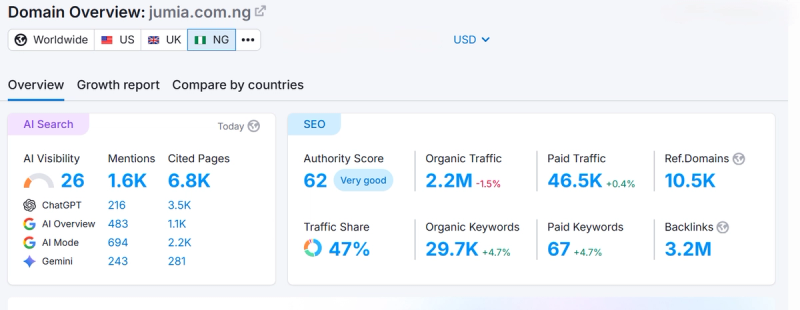
To put this into perspective: Because 75% of users rarely scroll past Google Page 1, these metrics translate directly into traffic and sales. For a commercial-intent keyword like "samsung price in nigeria" (which gets about 7,900 searches monthly and where Jumia ranks #1), Jumia captures roughly 47% of that traffic to their sales page.
That's 3,713 out of 7,900 people searching directed from Google to Jumia—for that keyword alone. And that's just one of the 29,741 keywords Jumia ranks for.
More importantly, most of that traffic is organic. Even if Jumia stopped all paid ads tomorrow (which generate only 46,500 monthly visits or 2% of total traffic), 98% (~2.2M monthly organic visits) of their traffic would remain. That's the power of owning your visibility through long-term SEO instead of renting it through sponsored ads.
Temu: Can't Win on Google? Flood Everything Else
When Temu entered the Nigerian market in 2023, they saw Jumia already ranking for the most important money keywords. They knew competing there would take 3-5 years. Unless, of course, if they wanted to settle for low-hanging opportunity keywords.
But they needed urgent visibility and, luckily, had the financial muscle of their Chinese parent company, PDD Holdings.
So they chose a different battlefield: paid ads. Everywhere.
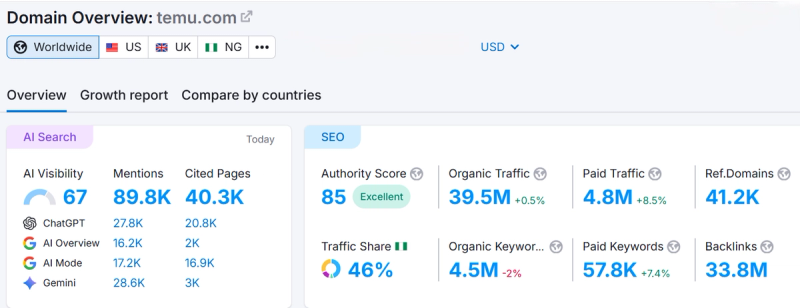
It paid off. The numbers (Note: worldwide metrics, not just Nigeria):
- 4.8 million monthly visitors from paid ads
- Authority Score: 85 (actually higher than Jumia's 62)
- 46% traffic share (similar to Jumia)
Open Facebook or Instagram? Temu ads everywhere. YouTube? Temu. TikTok? Temu. Click their link or download their app once, and push notifications and retargeting ads follow you for weeks.
But while Temu gets a massive 4.8 million paid visits each month (with an estimated monthly ad spend of ₦700M+ at ₦1,500/$1 and more than double Jumia's 2.2 million monthly organic visits), they only manage 7,300 organic visits.
The implication is that because the bulk of buyer traffic is from paid ads, if Temu stops ads tomorrow, 99.85% of their traffic might disappear — compared to Jumia, which would lose only 2% in the same situation.
Bokku: Owning the Streets Through Powerful Brand Recall
Unlike the other two, Bokku's (Atreos Retail Limited) digital presence is minimal. And that's understandable. After all, the brand is a physical retail store, not e-commerce. But on the streets, they've sharpened the art of brand marketing.
Their first winning stroke? A memorable brand name that resonates culturally. In Nigeria, when people say “the thing bokku,” that’s local parlance for “it’s plenty” or “surplus,” and it conveys satisfaction.
Besides, the trademark name "Bokku" is only 2 syllables. In other words, a short, memorable, and relatable name that's culturally connected to the target market. A stroke of genius!
Try remembering "Atreos Retail Limited" (the actual company name)in place of "Bokku" (the trademark name) for a change.
You can't.
Next strategy: Be everywhere physically. Not 1 or 2 mega stores in a city, but 5 -7 smaller, fully stocked outlets with beautiful layouts and distinctive blue‑and‑yellow branding plus architecture on the exterior at nearly every major bus stop.
You're never more than a short walk or drive from a Bokku. It's your neighborhood mega store.
They also introduced a pricing idea that drew attention: separating shopping bag costs from product prices and making items appear cheaper on the shelf. Shopping bags became optional. Customers could either pay separately for a bag at checkout or choose not to get one.
Cultural shock at first? Yes. A few people frowned. Then adjusted. It also resonated with their core brand promise of “lower prices”.
The result? The young Bokku brand quickly established itself as an innovator and market leader, because most other mega stores copied the idea rather than continuing to pretend their shopping bags were free.

Then came perhaps their most popular item: Bokku bread. Within a year, this hero product became shorthand for quality bread. Some have even made "Bokku" a generic name for bread and say "I'm going to buy Bokku" instead of "I'm going to buy bread."
Key Takeaways
There are several insights buried in these brand stories, but four stand out:
- Play in blue oceans, not red oceans. When your major competitors already dominate one channel, find a different battlefield. Temu saw Jumia owned Google search and chose paid social instead. Bokku avoided digital entirely and dominated offline.
- Stand out like a green apple in rows of red apples. Be innovative. Go in the opposite direction when everyone else zigs. Bokku's bag pricing strategy was controversial, then it became the industry standard.
- Adopt multiple strategies, but anchor on one. While using multiple brand marketing channels, anchor your efforts on the one most effective tool that fits your brand's unique needs and where your major competition doesn't dominate. Let the rest play complementary roles.
- Names are not just names. Your chosen brand name could be your first winning hook and leverage to leap ahead of current market leaders—if it resonates and connects at a deep, sentimental level with your target buyers. Logos and name lengths also matter. Don't just delegate these to a graphic designer. Work with a brand strategist or designer who understands positioning, then gives guidelines to a logo designer.
So, Which Strategy Fits Your Business?

If you have time but limited budget, build SEO like Jumia. If you have capital but need fast results, flood the zone with ads like Temu. If you have physical presence and cultural insight, own the streets like Bokku.
The worst move? Trying all three at once with ₦200,000. You'll rank for nothing, your ads won't run long enough, and your offline presence will be too scattered.
Pick one battlefield. Commit for 6-12 months. Dominate it. Then expand.
Want help choosing your strategy? Tekfolio can assess your market position and build a plan that fits your reality → Request a free strategy assessment.